Scholarships are one of two forms of financial aid that do not need to be repaid. They are awarded based on a student's academic or athletic achievement, demographic, cultural or religious background, or special skills and talents.
\Given the breadth of available public and private scholarships, you might wonder where to find those that align with your background and future plans. One way is to check with the financial aid office of each college you may attend.
While an institution might offer you a scholarship as part of the financial aid package without additional paperwork, you may also need to search and apply for specific scholarships. Additionally, some colleges require students to complete the CSS Profile, (an in-depth assessment of financial need) for scholarship consideration. As a rule of thumb, expect colleges to request you fill out the FAFSA to determine your financial need.
Below are the scholarship programs provided by the State of Minnesota and administered by the Minnesota Office of Higher Education (OHE). You may also want to review additional grants and scholarships from other sources on the OHE's website.
North Star Promise
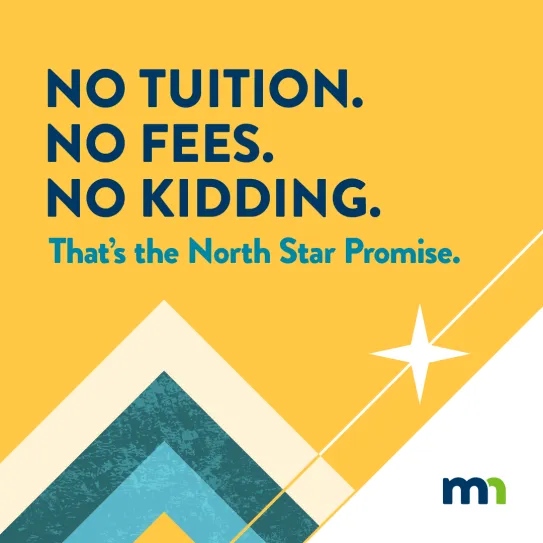
Beginning in fall 2024, the North Star Promise (NSP) Scholarship program will create a tuition and fee-free pathway to higher education for eligible Minnesota resident students at eligible institutions as a "last-dollar" program by covering the balance of tuition and fees remaining after other scholarships, grants, stipends and tuition waivers have been applied.
How much money can you receive?
There is not a limit on the maximum term, yearly, or lifetime awarded dollar amount. The amount a student shall receive is based on the "last-dollar" calculation on a term-by-term basis. You can receive up to 100% of the amount charged in tuition and required fees per term, minus all other sources of gift aid already awarded to you.
- For students earning 2-year degrees, they can receive the award for a total of 60 credits
- For students earning 4-year degrees, they can receive the award for a total of 120 credits
If funds are available, the highest need students may also receive North Star Promise Plus funds. The details on this provision of the program are still being determined.
Eligibility
Eligible students must:
- Be a Minnesota resident student
- Have a family Adjusted Gross Income* (AGI) as reported on the Free Application for Federal Student Aid (FAFSA) or Minnesota Alternative State Financial Aid Application below $80,000
- Attend a Minnesota public higher education institution or Tribal College
- Not be in default on a state or federal student loan
- Be enrolled taking at least one credit
- Meet Satisfactory Academic Progress (SAP) standards
- Have not already earned a baccalaureate degree
- Be enrolled in a program or course of study that applies to a degree, diploma, or certificate
All Minnesota public higher education institutions and Tribal Colleges will be eligible:
- All Minnesota State Colleges and Universities
- All University of Minnesota campuses
- All Tribal Colleges
An institution may offer programs that are not eligible for Federal Title IV Aid and Minnesota financial aid. Typically, this is because the program length is too short to meet requirements for federal and state financial aid.
Application
- Complete the Free Application for Federal Student Aid (FAFSA) or Minnesota Alternative State Financial Aid Application
- There is no additional application beyond the FAFSA or Minnesota Alternative State Financial Aid Application. The eligible college or university you are attending will assess your eligibility on a term-by-term basis and award North Star Promise Scholarships to all eligible students.
- Priority Application Deadline: For the 2026-27 academic year, The Minnesota Office of Higher Education set a priority deadline of June 1, 2026, for eligible students to apply for financial aid and be considered for a North Star Promise scholarship. While a determination has not yet been made around instituting a priority deadline for the 2027-28 academic year, eligible students are encouraged to fill out their FAFSA or Minnesota Alternative State Financial Aid Application as soon as possible to ensure maximum consideration for financial aid. Both the FAFSA and Minnesota Alternative State Financial Aid Application open on October 1, 2026, for the 2027-28 academic year.
Award Process
The college or university you are attending will calculate your award amount based on the eligibility requirements and award calculation. They will determine your tuition and required fee charges, subtract all other sources of gift aid (scholarships, grants, waivers and stipends) and award the remaining amount in a North Star Promise scholarship.
You shall be notified of your awarded scholarship through your college or university’s standard awarding process.
For more information:
First, review North Star Promise Scholarship Frequently Asked Questions. If you can't find the answer to your question, please send an email to NorthStarPromise.OHE@state.mn.us
Shareables
Download and share the following:
- Fact Sheets: in English, Spanish, Hmong, and Somali
- Frequently Asked Questions
- Social media: Graphics are sized 1080 x 1080 px and are available in .JPEG format. To download an image, right click on the image and select "Save Image As."



Minnesota Indian Scholarship Program
Scholarships are available to eligible American Indian students who are either undergraduate students enrolled at least three-quarter time, or graduate students enrolled at least half time.
Eligibility
To qualify for this scholarship, you must be:
- One-fourth or more American Indian OR an enrolled member or citizen of a federally-recognized American Indian tribe or Canadian First Nation;
- Minnesota resident student for state financial aid purposes;
- Apply for other existing state and federal scholarship and grant programs;
- Enroll at least ¾ time as an undergraduate OR ½ time as a graduate student in an education program leading to a certificate, diploma, or degree at an accredited postsecondary institution in Minnesota;
- Meet Satisfactory Academic Progress (SAP);
- Are not in default on a federal or state student loan or, if in default, have regained eligibility for federal or state student aid; and
- Qualify for either a Pell or State Grant and demonstrate financial need as an undergraduate student OR demonstrate financial need as a graduate student.
Awards
The annual award amount is up to $4,000 per academic year for undergraduate students and up to $6,000 per academic year for graduate students.
- Students enrolled in two-year degree, certificate, or diploma programs are limited to 3 annual awards or the equivalent (6 semesters, 8 quarters).
- Students enrolled in four-year degree programs are limited to 5 annual awards or the equivalent, including any awards received while enrolled in a less than 4-year degree program (10 semesters, 14 quarters).
- Students enrolled in graduate or professional degree programs are limited to 5 annual awards or the equivalent (10 semesters, 14 quarters).
An annual award may include one eligible summer term, which will count towards the equivalent annual maximums.
Students may receive up to 10 annual awards or the equivalent in a lifetime (5 awards at undergraduate level + 5 awards at graduate level).
Students may receive the scholarship for only one degree per educational level and one terminal graduate degree.
Application
Students should complete the FAFSA or Minnesota Alternative State Financial Aid Application, an application for tribal education funds, and complete:
The priority deadline for complete applications is July 1.
Other Financial Aid Resources for American Indian Students
Please review all American Indian Student Resources on OHE's website.
Here is a list of additional resources:
- Map of Tribal Scholarship/Education Programs
- Native American Scholarship Database
- Augsburg American Indian Recognition Full Tuition Scholarship
- American Indian College Fund
- Cobell Scholarship Program
- Ethel Curry American Indian Leadership Scholarship at the Minnesota Department of Education
- Maureen L. and Howard N. Blitman, P.E., Scholarship to Promote Diversity in Engineering
- Minneapolis American Indian Center
- Native Forward Scholars Fund
- Indian Health Service Scholarship Program
MN Indian Scholarship
Minnesota Paramedic Scholarship
The Minnesota Paramedic Scholarship is a temporary financial aid program for Minnesota residents completing a paramedic diploma or degree. The program will provide up to 600 scholarships of $5000 each starting Fall 2024 to be awarded by June 30, 2026.
Eligibility
Eligible students are Minnesota resident students attending an eligible paramedic program. Students must enrolled in any of the following paramedic program courses to receive the scholarship:
- Rochester Community and Technical College
- Emergency Medicine Paramedic AS (75 credits)– 20-month program in affiliation with the Mayo Clinic School of Health Sciences.
- Minnesota North College
- Paramedic AA Degree (67 credits)
- Paramedic Diploma (52 credits)
- Century College
- Paramedic Fire Science AAS (68 credits)
- Paramedic AAS (60 credits)
- Paramedic Diploma (47 credits)
- Anoka Technical College
- Paramedic AAS Degree (60 credits)
- Paramedic Diploma (45 credits)
- Ridgewater College
- Paramedic AAS Degree (60 credits)
- Paramedic Diploma (46 credits)
- Saint Cloud Technical and Community College
- Paramedicine AAS Degree (60 credits)
- Northland Community and Technical College
- Paramedic AAS Degree (60 credits)
- Paramedic Diploma (48 credits)
- South Central College
- Intensive Care Paramedic Technician AAS Degree (67 credits)
- Intensive Care Paramedic Technician Diploma (58 credits)
- Inver Hills Community College
- EMS AS Degree (70 credits)
- Paramedic Diploma (40 credits)
All eligible programs require students to be a current Emergency Medical Technical (EMT) license holder before starting the program. Each institution has individual prerequisite requirements. Please review the individual program requirements to enroll with your selected institution.
If you are not an EMT license holder but would like to become a paramedic, you may still be able benefit from the scholarship if you take action quickly. All of the institutions with eligible programs offer EMT programs that can be completed before the start of their paramedic programs.
Application
The 2025-2026 Paramedic Scholarship Application is for students starting in Fall 2025, Spring 2026 or Summer 2026
There are only 600 scholarships are available. Secure yours as soon as possible. Submit your application today!
Award Process
Applications will be reviewed in order of date submitted with confirmation of enrollment from the institutions.
Student award notices will be sent from the Minnesota Office of Education.
Scholarship funds will be sent out starting Fall 2024. All funds will be sent to institutions to be applied to the student’s account.

Private Scholarships
Many community organizations, foundations, corporations, clubs, civic, and cultural groups provide student scholarships.
If you’re looking for private sources of financial aid, you should:
- Check with your or your family’s employer, professional association, or labor union.
- Ask if your employer has an education policy that pays for employees to enroll in job-related postsecondary courses.
- Inquire at community organizations such as the Chamber of Commerce, churches, or Rotary Clubs.
- Check with your high school counselor.
Before you accept any scholarships review the scholarship tips below. In addition, be wary of any scholarship search companies charging fees, guarantying scholarships, and asking for your credit card or checking account information to receive a scholarship.
Find a Scholarship
Scholarship Tips
1. Ask questions
As you search for scholarships, asking the questions below will help you determine whether there is a good match between each scholarship program and your circumstances and educational goals.
- What is the maximum scholarship award?
- Is the scholarship one-time only or can it be renewed beyond the initial award?
- Is the scholarship based only on merit (no financial need requirement), or does it require both merit and need?
- How is financial need defined for scholarships that require need?
- How does the scholarship program define merit?
- Does the scholarship require admission to a degree-granting program?
- Does the scholarship require full-time enrollment?
- What are the other eligibility requirements?
- Is the scholarship targeted to a specific educational institution, specific field of study or major, residents of a specific geographic area, first bachelor's degree, or master's or doctoral level programs?
- Is a personal statement or essay required?
- Are letters of recommendation required?
- Is an interview required?
- What is the application process?
2. Reach out to the institutions in your community
Search for scholarships available in your community or from your educational institution. Generally, you have the best chance of receiving scholarships from these sources.
3. Be aware of scholarship deadlines
Scholarship deadlines can be six to nine months preceding the start of the academic year, while others may be closer to the start of the fall term. Some scholarship programs also accept applications for spring and summer terms.
4. Find out how your prospective college applies external scholarships
Many schools allow students to combine outside scholarships with financial aid the school has awarded with no impact on the student's financial aid package unless total aid (including the outside scholarship) exceeds the total cost of attendance. If it does, loans and work-study are reduced first, usually eliminating the need for a reduction in scholarships and grants awarded by the institution. However, some institutions reduce dollar-for-dollar scholarships or grants they have awarded when students receive outside scholarships. Check with each school to inquire about its policy.